Definitions
The imaginary unit $i$ is defined as $i = \sqrt{-1}$. In other words $i^2 = -1$.
Imaginary numbers are of the form $bi$, where $b$ is a real number and $i$ is the imaginary unit. Complex numbers are linear combinations of real and imaginary numbers.
The real part of $z$ is $\text{Re}(z) = a$ and the imaginary part of $z$ is $\text{Im}(z) = b$ (see Figure 1).
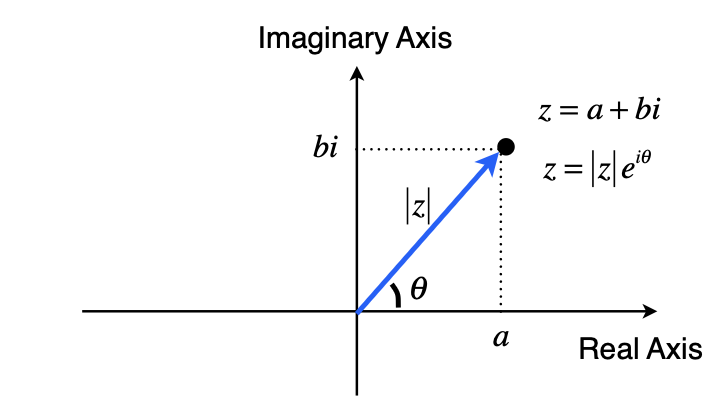
Figure 1: Complex plane with real and imaginary axes..
The complex conjugate may be thought of as a reflection across the real axis in the complex plane (see Figure 2). It is simple to show that the complex conjugate of any complex number may be found by simply replacing $i$ with $-i$ even in more complicated expressions where $i$ appears multiple times, in the denominator, etc.
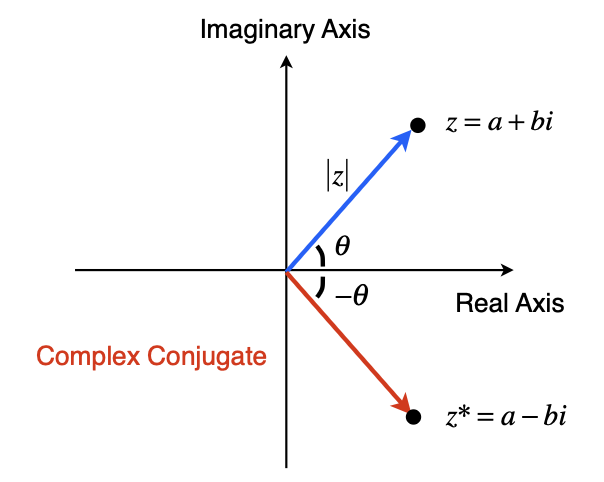
Figure 2: Complex conjugate $z^*$ in the complex plane..
The modulus $|z|$ of a complex number $z$ is defined as the distance from the origin to the point in the complex plane. The square of the modulus is equal to the product of the complex number and its conjugate:
Proof. We can write $z$ as $z = a + bi$ and $z^* = a - bi$. After cross-multiplying, and substituting $i^2 = -1$, we get:
Polar Form
If we introduce $\theta$ as the angle from the real axis to the point defined by $z$, then we can interpret $|z| \cos \theta$ as the projection of $z$ onto the real axis and $|z| \sin \theta$ as the projection of $z$ onto the imaginary axis (see Figure 1).
Euler's Formula
Euler's formula gives us an elegantly compact way to write the the polar form of complex numbers $z$ using the exponential function:
This formula is a direct consequence of the Taylor series expansions of the exponential function and the sine and cosine functions.
We can now use Euler's formula to write our complex number $z$ in terms of polar coordinates:
Notice that this result tells us that whenever we see a complex exponential $e^{i \theta}$, we can think of the value multiplying the imaginary unit $i$ ($\theta$ in this case) as an angle in the complex plane.
The real and imaginary parts of the complex exponential $z = |z| e^{i \theta}$ are shown in Figure 3.
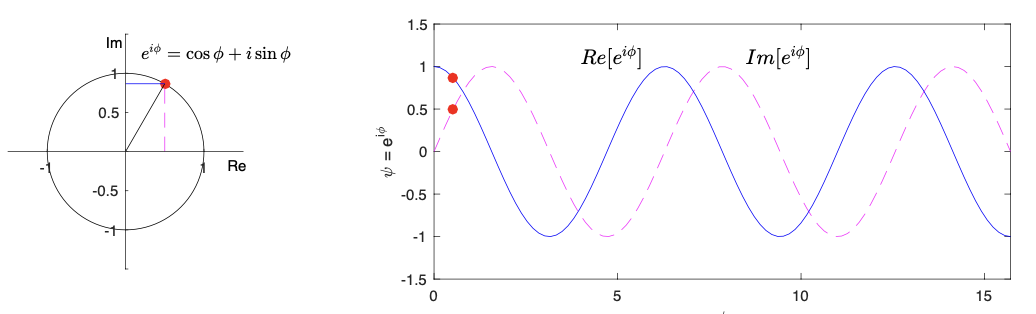
Figure 3: Real and imaginary parts of the complex exponential $z = |z| e^{i \theta}$..
Solution:
The simple way to find the complex conjugate of a complex number is to simply replace each instance of $i$ with $-i$:
Unit Circle
The unit circle in the complex plane may be defined as all complex numbers with modulus one, $|z| = 1$. Thus,
Let's plug in some values for $\theta$ to see what we get:
We can plot these points on the unit circle in the complex plane (see Figure 4):
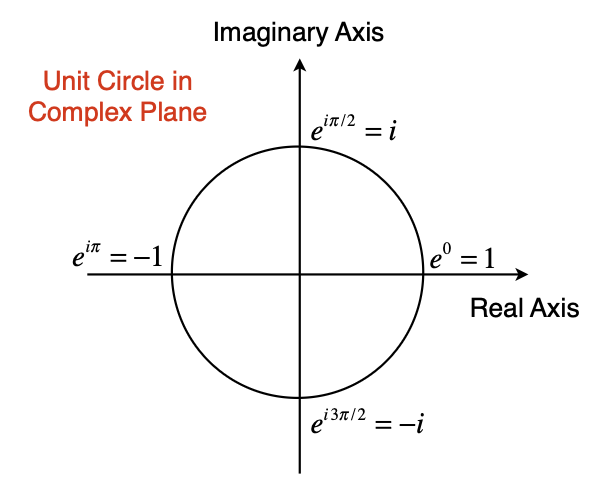
Figure 4: Unit circle in the complex plane.
Operations with Complex Numbers
Addition and Subtraction
Addition of complex numbers is very similar to the addition of vectors. We simply add the real and imaginary parts independently. For example, if we have two complex numbers $z_1 = a_1 + i b_1$ and $z_2 = a_2 + i b_2$, then their sum is given by:
It is almost always easier to add complex numbers in their rectangular form $a + ib$ rather than in their polar form $e^{i \theta}$.
Subtraction of complex numbers is similar to addition. We simply subtract the real and imaginary parts independently.
Multiplication and Division
When multiplying two complex numbers, we can either use the rectangular $a+bi$ form or the polar $|z|e^{i \theta}$ form.
In the standard form, we "foil it out" and and group the real and imaginary terms:
Let's now multiply complex numbers in polar form. Given two complex numbers $z_1 = |z_1| e^{i \theta_1}$ and $z_2 = |z_2| e^{i \theta_2}$, their product is given by:
Interactive Complex Number Multiplication
This visualization shows how two complex numbers multiply in the complex plane. The product $z_1 \cdot z_2$ has a modulus equal to the product of the moduli and an angle equal to the sum of the angles.
Result: Modulus: 1.0 | Angle: 0.0 rad
Division of complex numbers is similar to multiplication. We simply divide the modulus of the two numbers and subtract the angle of the second number from the angle of the first number: Given two complex numbers $z_1 = |z_1| e^{i \theta_1}$ and $z_2 = |z_2| e^{i \theta_2}$, their quotient is given by:
Multiplication by $e^{\pm i \phi}$
Let's see what happens when we multiply a complex number $z=|z| e^{i\theta}$ by $e^{i \phi}$:
We see that the resultant complex number simply rotates in the complex plane by an angle $\phi$ without changing its "length" $|z|$:
Similarly, multiplying by $e^{-i \phi}$ is equivalent to a rotation by $-\phi$ radians in the complex plane.
Negation
The negative of a complex number may be found by negating both the real and imaginary components
We can also substitute $e^{i\pi} = -1$ into the expression for $-z$ to get:
Thus, negation may be seen as a rotation by $\pi$ radians in the complex plane.
Simplifying Complex Numbers
When a complex number is in the denominator of a fraction, we can simplify the expression by multiplying by the numerator and denominator by the complex conjugate of the denominator.
Solution:
We can simplify the expression by multiplying by the numerator and denominator by the complex conjugate of the denominator: