2.4 - Vertical Motion with Stokes Drag
Introduction
This page continues our exploration of objects moving under the influence of Stokes drag that is applicable to motion in viscous fluids or microscopic particles moving slowly through air. This page examines an object falling through a fluid (such as air), under the influence of gravity and Stokes drag.
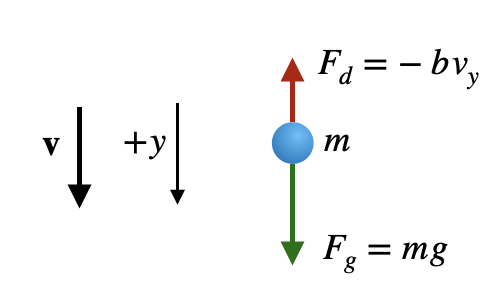
- Motion is along the vertical $y$ axis. We define the positive direction $+y$ to point downward.
- Drag force: $F_d = -bv_y$, where $b = 6\pi \eta r$ is the linear drag coefficient.
- Initial conditions: $v_{0y}$ and $y_0$. We'll take the starting point as the origin, i.e. $y_0 = 0$.
The Equation of Motion
According to Newton's second law, the net force on the particle equals its mass times acceleration. We have two forces acting:
- Gravitational force: $F_g = mg$ (downward, positive direction)
- Drag force: $F_d = -bv_y$ (opposes motion, upward when falling)
We substitute $a = \frac{dv_y}{dt}$ and rearrange to obtain:
Following the procedure in the previous lecture, we simplify the equation of motion by introducing the characteristic time:
Using this characteristic time scale, we can rewrite the equation of motion as:
Notice that each term in the equation has units of velocity per time, so the equation is dimensionally correct.
Terminal Velocity
Even without solving the equation of motion, we can understand something important about the long-term behavior of the falling object. Imagine an object falling from rest. As its velocity increases, the drag force $bv_y$ increases. As the drag force approachs the gravitational force, the acceleration will asymptotically approach zero
and we can rearrange the equation as
We define the terminal velocity as the object's velocity in the limit of infinite time:
At terminal velocity, the object falls at a constant speed. This represents the long-term behavior: regardless of the initial velocity, the object will eventually approach this terminal velocity. The time scale for reaching terminal velocity is approximately $\tau$.
The terminal velocity depends on:
- Mass: Heavier objects have higher terminal velocities (proportional to $m$)
- Drag coefficient: Objects with larger drag coefficients have lower terminal velocities (inversely proportional to $b$)
- Gravitational acceleration: Higher $g$ leads to higher terminal velocity (proportional to $g$)
This analysis shows that we can understand the asymptotic behavior of the system without needing to solve the full differential equation. The complete solution (derived below) will confirm that the velocity indeed approaches this terminal value exponentially.
Analytical Solution for Velocity
To solve the equation of motion $\frac{dv_y}{dt} = g - \frac{v_y}{\tau}$, we use separation of variables:
Integrating both sides with the initial condition $v_y(0) = v_{0y}$:
The left side can be integrated using the substitution $u = g\tau - v_y'$, giving:
Taking the exponential of both sides and rearranging gives the solution for the velocity $v_y(t)$:
This shows that the velocity approaches the terminal velocity $v_{\text{term}} = g\tau$ (which we found earlier) exponentially. If the object starts from rest ($v_{0y} = 0$), the solution simplifies to:
The characteristic time scale $\tau$ is the time it takes for the velocity to approach its terminal value (specifically, the time to reach $1 - 1/e \approx 63\%$ of the terminal velocity when starting from rest).
Analytical Solution for Position
To find the position as a function of time, we integrate the y-component of velocity:
Performing the integration:
Simplify and substitute the terminal velocity $v_{\text{term}} = g\tau$ to get the position solution:
If the object starts from rest ($v_{0y} = 0$), this simplifies to:
For large times, the exponential term becomes negligible, and the position approaches $y(t) \approx g\tau t - g\tau^2$, which is the position of an object moving at terminal velocity with a constant offset.
- The velocity approaches terminal velocity exponentially: $v_y(t) \to v_{\text{term}} = g\tau$ as $t \to \infty$
- The characteristic time scale is $\tau$
- At $t = \tau$, when starting from rest, the velocity reaches approximately $63\%$ of terminal velocity
- For large times, the position grows approximately linearly with time: $y(t) \approx v_{\text{term}} t + \text{constant}$
Physical Interpretation
The linear drag model is most appropriate for:
- Low Reynolds numbers: When the flow around the object is laminar (smooth)
- Small objects: Such as dust particles, small droplets, or particles in viscous fluids
- Low speeds: When the drag force is dominated by viscous effects rather than inertial effects
For larger objects or higher speeds, the drag force is often better modeled as quadratic in velocity ($F_d \propto v^2$), which leads to different dynamics and a different expression for terminal velocity.
Mathematical Summary
These analytical solutions are exact and valid for all times $t \geq 0$. They demonstrate the exponential approach to terminal velocity and the resulting position as a function of time.
Falling Motion of Water Drops with Stokes Drag
Stokes drag fall time: -- ms
Terminal velocity: -- m/s
Reynolds number at impact: --
Consider a small water droplet falling through air. For very small droplets (diameter on the order of micrometers), the linear drag model (Stokes drag) is appropriate. The drag coefficient for a sphere in a viscous fluid is given by Stokes' law:
where $\eta$ is the dynamic viscosity of air and $r$ is the radius of the droplet.
For a water droplet with diameter $d = 1$ μm ($r = 0.5$ μm = $5 \times 10^{-7}$ m):
- Density of water: $\rho_{\text{water}} = 1000$ kg/m³
- Volume: $V = \frac{4}{3}\pi r^3 = \frac{4}{3}\pi (5 \times 10^{-7})^3 \approx 5.24 \times 10^{-19}$ m³
- Mass: $m = \rho V \approx 5.24 \times 10^{-16}$ kg
- Dynamic viscosity of air: $\eta \approx 1.8 \times 10^{-5}$ Pa·s (at room temperature)
- Drag coefficient: $b = 6\pi \eta r = 6\pi (1.8 \times 10^{-5})(5 \times 10^{-7}) \approx 1.70 \times 10^{-10}$ N·s/m
- Gravitational acceleration: $g = 9.8$ m/s²
Terminal Velocity
First, we calculate the characteristic time scale:
The terminal velocity is then:
The terminal velocity is approximately $0.0302$ mm/s. This is extremely slow!
Time to Fall 1 Meter
To estimate the time it takes for the droplet to fall 1 meter, we can use the position equation. The characteristic time $\tau \approx 3.08 \times 10^{-6}$ s (calculated above) is about 3 microseconds, which is much shorter than the time to fall 1 meter. Therefore, the droplet reaches terminal velocity almost immediately. For large times (much greater than $\tau$), the position is approximately:
Setting $y = 1$ m and solving for $t$:
Calculating the offset term:
This offset is negligible compared to 1 meter, so:
Converting to more convenient units:
It takes approximately 9.2 hours for a 1-micron diameter water droplet to fall 1 meter through air!
This demonstrates why tiny water droplets can remain suspended in the air for extended periods, forming clouds and fog. The extremely small terminal velocity means that even slight air currents can keep these droplets aloft.